
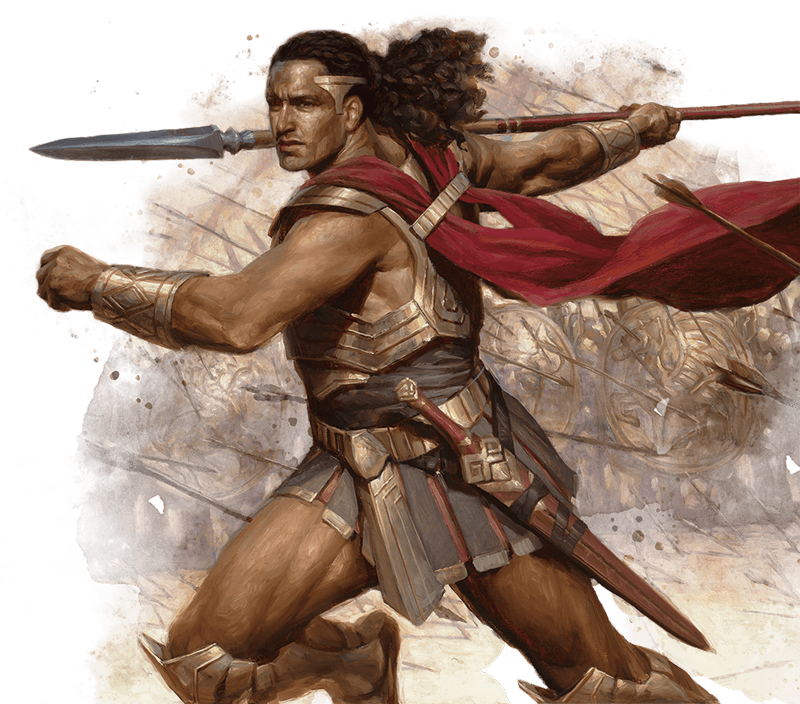
Captain…Captain Matthias…yes, you were a captain. Briefly. Something to do with your upbringing. That’s right. A foundling.
Memories flood your mind. A foundling.
You were found by a childless couple, serfs to a land owner and retired King’s Guard slaving on his property north of Akros where cotton fields and olive trees were groomed and harvested. You were two years old, cradled among the knotty roots of a larger tree, cuddled with a fleecemane lion cub. How you got there and with the cub is anyone’s guess, except for the myriad of scratches, some decently deep, and the brambles wrapped around both yours and the lion cub’s legs, chaining you together.
However, judging by your relatively scrawny frame and the rare fair skin and blond hair, and the glaring, intricate flourish of birthmarks on your chest and shoulders, your guardians could only guess that you were abandoned at the foot of Mount Velus, a towering active volcano within site of Akros, where all unwanted or “unfit” infants are left.
Akros, and most of Theros, you recall, is a rigid and uniform society, with stringent expectations that align with a harmonious, strong, and stalwart nation. Citizens have little flexibility in thought and behavior. Connecting the dots between your appearance and society’s expectations and the common practice, wasn’t difficult.
Turns out, you were anything but “unfit.”
The couple unofficially adopted you, and from even that early age, you learned to till the fields, climb trees, harvest cotton, dragging full baskets from tree to cart and field to mill. Your strength impressed the retired King’s Guard. And while drafting a Helot into military service was still rare, the King’s Guard recommended you to the local magistrate, and at seven years old, you went to to the agoge regime, where you were subjected to vigorous and intense physical and militaristic training.
For you, even more so. Because of your outward appearance and your “serf” background, both the boys and the “instructors” were openly and blatantly hard on you. While the other boys were met with equal challenges, the trainers increased levels of difficulty for you, simply so you would fail out and be sent back to the fields.
One particular obstacle had you scaling a wall twice as tall, with shards of volcanic rock cemented at the bottom. Once on the wall, you realized the handholds were greased.
Unless one had the power to walk up walls, no one could have climbed to the top.
But still, you climbed higher than the height of the standard wall, and fell when leaping to grab an impossible hold on an overhang. You dropped (Athletics 13) nearly 30 feet, landing on the volcanic rock. Now, ten years old, you were aware enough and been trained enough to know of the serious damage you had taken. Bleeding internally, a broken rib, perhaps a collapsed lung. Head wound was gushing.
But you picked yourself up and limped back to the wall, and, wiping blood dripping into your eyes, you latched back on. (CON 27)
And climbed.
And climbed.
The other boys gathered below, one began cheering. The others joined in. They began calling out a word, Asteria! Asteria!
You reach the overhang, but this time, drawn by your own will or the cheers from the previously persecuting boys, you leap and grab the hold crimping your fingers to lock against the ledge, and swing yourself over, climbing another 30 feet to the top. (Athletics 27)
Perhaps in a moment of adulation and emotion, finally hearing the boys cheering and chanting, you join in with tears welling, Asteria! Asteria!
To the stars.
But as you chanted the defining word, in your heart, you called out the slightly varied definition…
Of the stars…
Your adulation was quickly overcome by loss of blood, and blinding pain in your ribcage and leg. You faint, falling, with your frame teetering over the edge of the wall.
The next memory you have is waking up in the infirmary, your leg, core, and head wrapped, massive bruising covering most of your body.
After such a display of courage, will, and toughness, you were finally accepted by your classmates and your instructors, though many of them still begrudgingly. But there is no finer currency in Akros than strength of arm and strength of will. Your sheer force of personality also emerged, learning how to persuade to avoid physical conflict as much as proving your prowess in battle.
From that point on, until you joined the military, the other cadets called you “Asteria.” And those brave enough (usually cadets much older than you) wondered aloud if the reason for your fair skin and hair–and the bizarre birthmarks–was in fact because you were from the stars…